Scan types
ANTHRION runs nine scan types across six surfaces. Each one accepts a target (a URL, a public repository, or pasted text) and returns the normalized finding model. Start any scan from the dashboard at app.anthrion.xyz — see Your first scan for the full walkthrough.
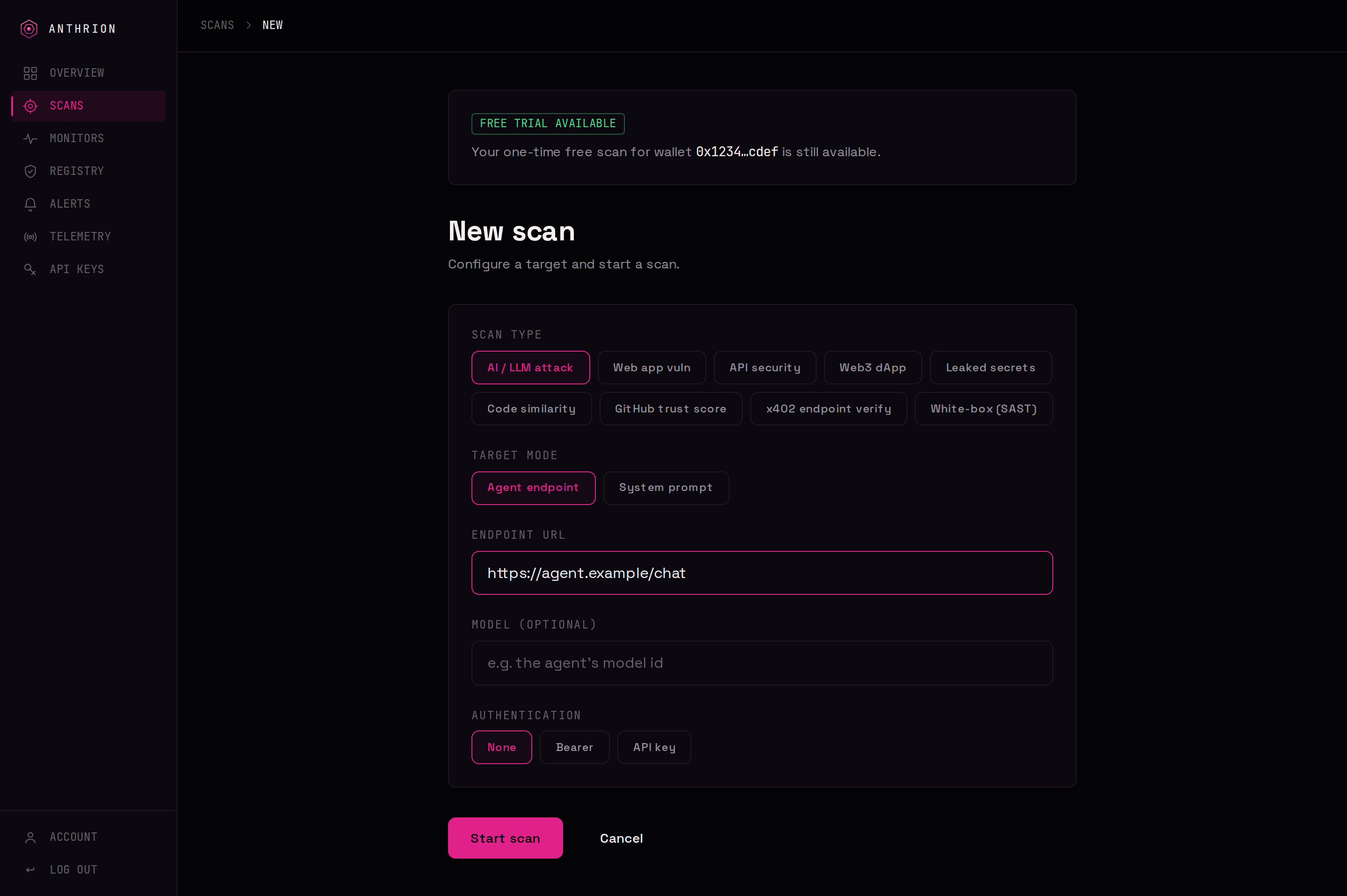
AI / LLM attack scan
The differentiator. An adaptive AI red-team: static probes escalate into an adaptive attacker that adjusts to your agent, rather than running a fixed checklist.
- Targets — a live AI endpoint (OpenAI-compatible), or a pasted system prompt to test it before you ship.
- Detects — prompt injection, jailbreaks, system-prompt leakage, excessive agency, insecure output handling, and related OWASP LLM Top-10 risks.
- Report — each finding names the technique, shows the exchange that demonstrated it, and recommends a mitigation.
Web app scan
Dynamic testing (DAST) of a live website in a real browser.
- Targets — a public site URL.
- Detects — injection, cross-site scripting, authentication and misconfiguration issues on the rendered surface.
API security scan
Probes an API for common server-side weaknesses.
- Targets — an API endpoint URL.
- Detects — broken authentication, injection and data-exposure issues across routes.
Web3 dApp scan
Checks what a dApp's frontend could ask a wallet to do, plus on-chain context.
- Targets — a dApp URL.
- Detects — wallet-injection and frontend risks, and surfaces on-chain context for the contracts the dApp interacts with. Read-only — ANTHRION never signs or sends a transaction.
White-box scan (SAST)
Static taint analysis of source code from a repository.
- Targets — a public GitHub repository URL.
- Detects — data-flow weaknesses such as SQL injection, command injection and path traversal, where untrusted input reaches a sensitive sink. Each finding shows the taint path.
Leaked-secrets scan
Finds credentials committed to a codebase.
- Targets — a public GitHub repository URL.
- Detects — hardcoded passwords, API keys and high-entropy secrets. Disclosure is masked — the report shows enough to locate a secret, never the full value.
Code-similarity scan
Measures how much a codebase overlaps with known code.
- Targets — a public GitHub repository URL.
- Detects — significant similarity to known libraries or other code, useful for spotting forks, copied code and license concerns.
GitHub trust score
Aggregates repository health and red flags into a single trust signal.
- Targets — a public GitHub repository URL.
- Detects — a health score plus separate red flags drawn from repository metadata and the code/secret scans above.
x402 endpoint verify
Checks whether a paid (x402) endpoint correctly and safely implements the protocol.
- Targets — an x402-enabled endpoint URL.
- Detects — a trust score (0–100) plus protocol red flags, so you — or an autonomous agent — can decide whether an endpoint is safe to pay before paying it. Read-only: the verify scan never pays.
Note
Endpoint trust extends beyond a one-off verify: ANTHRION can monitor an endpoint over time and list high-trust endpoints in a public trust registry. Explore both from the dashboard.